The first edition of our monthly, forward-looking guide to stablecoin yield. Five vetted opportunities for income-focused investors who want yield without touching the crypto spot market — sorted by risk, with the trade-offs spelled out.


Archived edition — July 2026. The first edition of this guide, kept as published. The figures are as they stood at the time and are no longer maintained. For the current board and our standing view, see the DeFi Yield Guide.
Starting this month, we will publish a regular, forward-looking guide to stablecoin yield investing. This report is written for investors who want steady income without touching the crypto spot market — no leveraged trading, no chasing tokens. We have done our best to surface the risks behind each opportunity, but please evaluate them carefully before committing capital. None of this is financial advice.
The AI sector's gravitational pull on capital has triggered a sharp pullback across the major crypto markets, and expectations of further Fed rate hikes have left overall sentiment cautious. The macro backdrop is challenging — but careful analysis still surfaces opportunities worth watching. As always, the core of the opportunity set sits in RWA (Real-World Assets).
As a baseline reference point: Robinhood's cash account currently offers 3.5% APY (you need a recurring direct deposit set up to keep the perk). Anything below that, for comparable risk, is not worth the on-chain complexity.
| Product | Protocol | APY | Risk | Where the yield comes from |
|---|---|---|---|---|
| sUSDe | Ethena | 3.93% | Low | Funding-rate arbitrage + US Treasuries (RWA) |
| sUSDS | Sky / Spark | 4.95% | Low | Stability fees + tokenized US Treasuries |
| USDG | Paxos | 5.5% (91-day) | Low | US Treasuries (regulated issuer) |
| USDAI / sUSDAI | USDAi | 6.91% / 8.67% | Medium | US Treasuries / GPU-backed loans |
| reUSD / reUSDe | Re | 10% / 15% | Medium | On-chain reinsurance premiums |
Benchmark: Robinhood cash account at 3.5% APY. All figures are point-in-time as of early July 2026 and change daily — verify on-chain before investing.
After its explosive growth in 2022, Ethena's treasury has settled into a steadier rhythm. In the current environment, a pure cash-and-carry (funding-rate arbitrage) strategy is increasingly hard to sustain on its own. Ethena's positioning has evolved: by bringing US Treasuries on board as collateral, it has pivoted decisively toward the RWA track.
sUSDe currently yields 3.93% on Pendle — slightly above our Robinhood baseline, with risk that stays contained. As a DeFi protocol that has now operated through several full market cycles, Ethena carries comparatively low systemic risk. The extra ~0.4% over the baseline is admittedly modest, but as a building block in a conservative allocation it remains a reasonable choice.
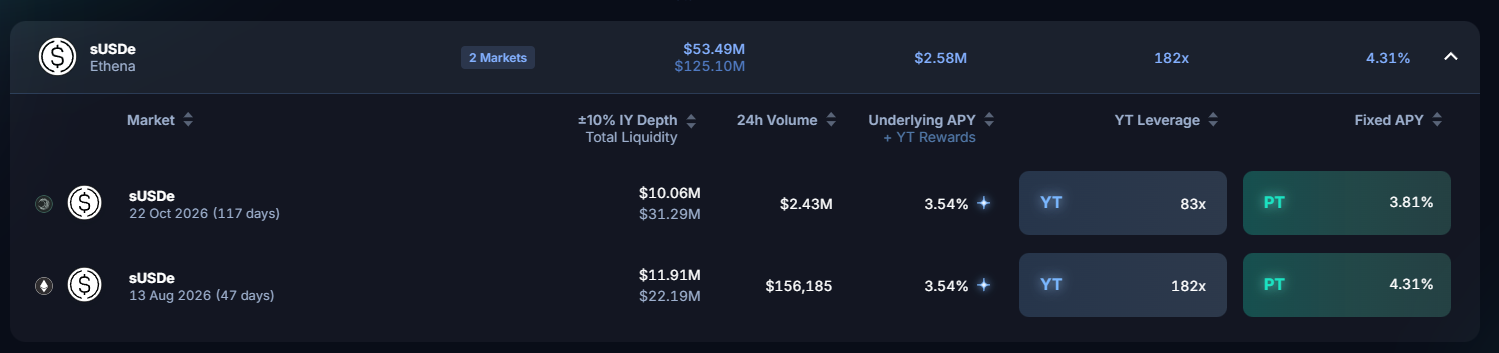 sUSDe fixed-yield (PT) markets on Pendle, across two maturities.
In the aftermath of the Aave-related fallout, Sky Money and Spark successfully absorbed a large share of the market, and USDS has become a genuinely competitive savings product.
sUSDS (Savings USDS) is the tokenized way for USDS holders to earn native yield. You deposit USDS and receive sUSDS, whose value steadily accrues the Sky Savings Rate — there is no lock-up, and you can redeem back to USDS at any time. Where does the yield come from? Sky earns revenue on the collateral that backs USDS: stability fees paid by over-collateralized borrowers on the protocol, plus returns from a growing book of tokenized short-term US Treasuries and other high-quality RWA. That revenue is what funds the savings rate.
The risks are low but worth naming:
These are mitigated by the simple fact that Sky (formerly MakerDAO) is one of the oldest and most battle-tested protocols in the space.
stUSDS (Staked USDS) generally refers to staked sUSDS, often bound to governance rights or specific liquidity-pool depth, and layers on extra incentive yield — at the cost of additional incentive-token and smart-contract exposure.
sUSDS currently yields roughly 4.95% APY. For full ratings, see Sky and Spark.
 The sUSDS fixed-yield (PT) market on Pendle.
USDG offers a 5.5% annualized yield on Pendle, maturing in 91 days. USDG is issued by Paxos, a tightly regulated fintech known for highly transparent, regulated stablecoin issuance and custody, earning primarily through US Treasury exposure. There is no elaborate mechanism here — the appeal is precisely its regulated, no-surprises profile. A clean choice for capital that values compliance over complexity.
 The USDG fixed-yield (PT) market on Pendle.
USDAi's investment thesis rests on its GPU lending business. The core risk is default risk in the GPU rental market — but our research team judges the probability to be low. NVIDIA is expected to release its "Robin" chip series around year-end, leaving a six-to-twelve-month buffer before mass production ramps. We note that the USDAi loan book includes a sizable H200 chip loan; a sharp drop in rental prices (say, below $2/hour) would be a danger signal, but rents are currently stable above $3/hour.
USDAi's Season 2 rewards end in mid-October, and the profit potential is still high. Buying YT (Yield Tokens) right now could deliver an ROI of over 100% — run the numbers in our calculator.
Two products, two risk profiles:
Looping strategies on platforms like Morpho and Fluid can amplify these returns. A concrete example: the sUSDAI–USDC loop on Fluid — supply sUSDAI at ~7.5%, borrow USDC at ~7%, with a max LTV of 90% (≈10× leverage). Net of borrowing costs, the looped APY lands around 12% (10 × 7.5% − 9 × 7%). The spread is thin, though: if sUSDAI's yield or price slips, the loop turns against you fast — so the core risk here is unchanged, and it is GPU loan defaults. Beware the leverage.
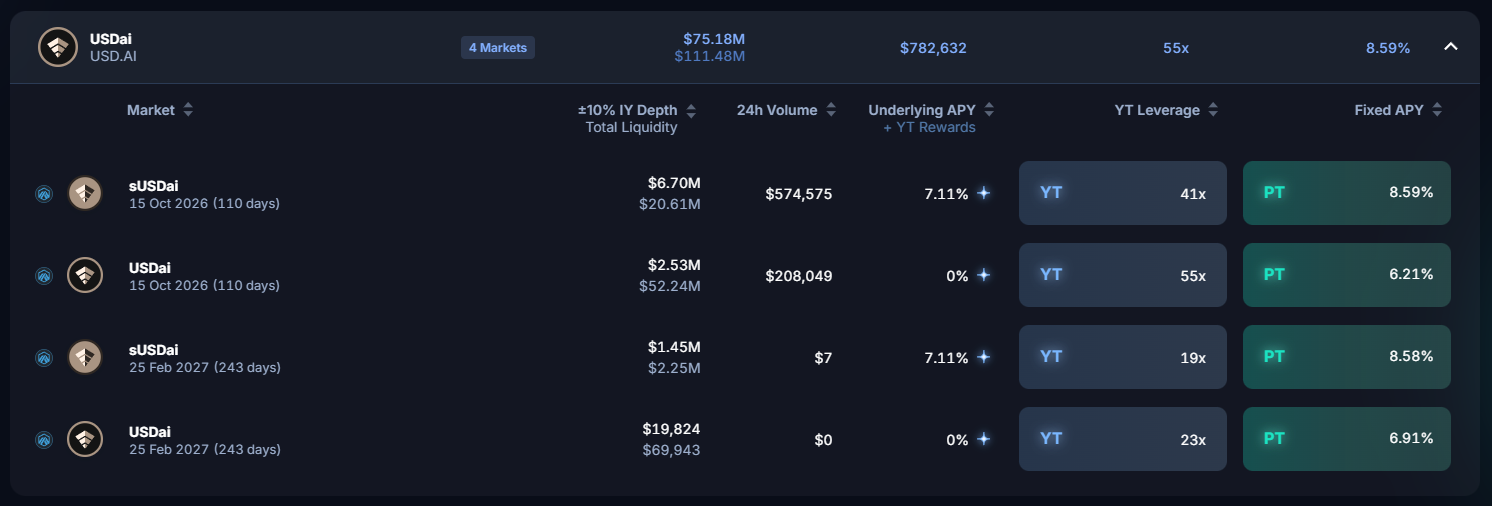 USDAi (US Treasury-backed) and sUSDAI (with GPU exposure) markets on Pendle, on Arbitrum.
→ Trade USDAI on Pendle · Trade sUSDAI on Pendle
Re is a DeFi project bringing the reinsurance business on-chain. Currently reUSD yields 10% and reUSDe yields 15% — the latter behaving like a junior tranche relative to the former. Reinsurance is a complex business, and investors should focus on the risk in the underlying insurance lines (homeowners and auto).
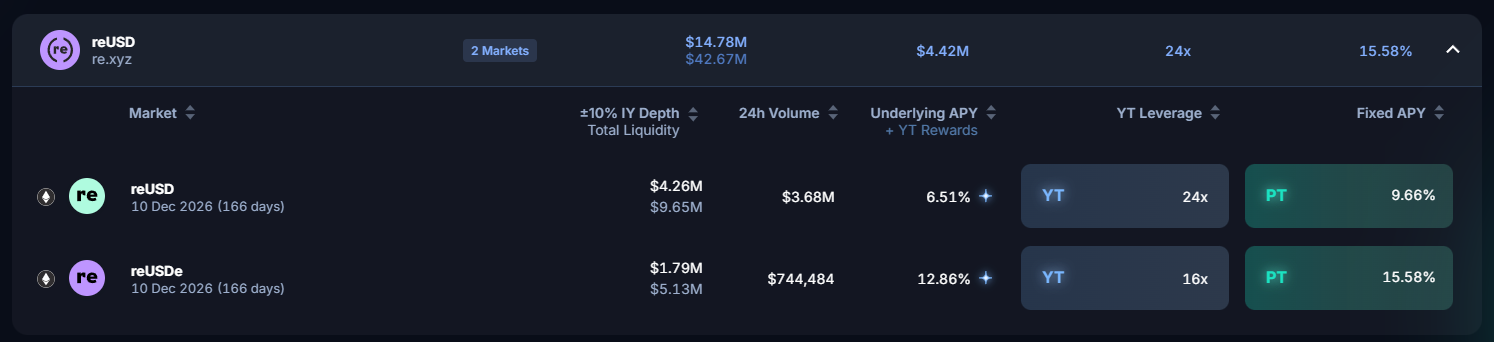 reUSD (senior) and reUSDe (junior tranche) markets on Pendle.
→ Trade reUSD — senior · Trade reUSDe — junior
reUSD can also be looped. With a supply rate of 6.3% (reUSD), a borrow rate of 4.07%, and a max LTV of 91.5% (≈11.8× leverage), the theoretical max APY works out to roughly 30% (6.3% + 10.76 × [6.3% − 4.07%]). That figure assumes you ride the LTV ceiling — leave headroom, because a junior-tranche payout event is exactly when liquidation pressure and yield compression arrive together.
For details, see Re on DeFi Sentinel.
This guide is for informational purposes only and is not financial advice. Yields, maturities, and risk conditions change quickly — always verify current figures on-chain before investing, and never commit more than you can afford to lose.
As of early July 2026, the standout low-risk stablecoin yields are sUSDe (Ethena) at 3.93%, sUSDS (Sky/Spark) at ~4.95%, and USDG (Paxos) at 5.5% on a 91-day Pendle market. For more yield at medium risk, USDAi pays 6.91% (Treasury-backed) to 8.67% (sUSDAI, with GPU-loan exposure), and Re's reUSD pays 10% (reUSDe 15%). The relevant TradFi benchmark is Robinhood's 3.5% cash account.
sUSDS is the savings version of Sky's USDS stablecoin. Holders earn the Sky Savings Rate, funded by stability fees from over-collateralized borrowers plus returns on tokenized short-term US Treasuries and other RWA. It currently yields about 4.95% with no lock-up. The main risks are low: the rate is a governance-set parameter that can be cut, plus collateral/peg and smart-contract risk — mitigated by Sky (formerly MakerDAO) being one of DeFi's most battle-tested protocols.
USDAI is backed by US Treasuries and yields around 6.91% — the comparatively safer of the two. sUSDAI is the staked version that adds exposure to USDAi's GPU-backed lending business and yields roughly 8.67%. The core risk in sUSDAI is GPU loan defaults: rents are stable above $3/hour today, but a drop below $2/hour would be a danger signal. USDAi's Season 2 rewards end in mid-October 2026.
Re brings the reinsurance business on-chain: reUSD yield (around 10%) comes from premiums earned underwriting real-world insurance lines, primarily homeowners and auto. reUSDe (around 15%) behaves like a junior tranche, taking first losses for higher reward. The key risk is seasonal catastrophe exposure — September hurricane peak and the April–June severe-convective-storm season are the highest-risk windows for payout events.
Looping amplifies yield but adds leverage risk. On Fluid, the sUSDAI–USDC loop supplies sUSDAI at ~7.5% and borrows USDC at ~7% with a 90% max LTV (about 10x leverage), reaching roughly 12% APY. Looping reUSD at a 6.3% supply rate, 4.07% borrow rate, and 91.5% max LTV (about 11.8x leverage) yields a theoretical max near 30%. Both assume you ride the LTV ceiling — leave headroom to avoid liquidation.
These are income-focused strategies that avoid spot-market price exposure, but none are risk-free. The low-risk picks (sUSDe, sUSDS, USDG) rest mainly on US Treasury and over-collateralized backing from established issuers. The medium-risk picks (USDAi, Re) carry real business risk — GPU-loan defaults and insurance-payout events respectively. Always verify current APYs on-chain, size positions conservatively, and never invest more than you can afford to lose. None of this is financial advice.

Practitioner turned analyst tracking how incentives, liquidity, and capital flows shape DeFi protocols.


