What every beginner must understand before putting real money on-chain.


Most people enter DeFi chasing APY. That's usually how they lose money.
After reviewing hundreds of DeFi protocols, yield strategies, and post-mortems from both bull and bear markets, one pattern is consistently evident: users fail not because DeFi is flawed, but because they approach it with the wrong mental model.
DeFi is not a bank account. It is not passive income. It is not "set it and forget it" in the way TradFi marketing teaches us. DeFi empowers every user to become their own asset manager. If you understand that single shift, everything else becomes clearer.
This article walks through the essential truths you need to know before making your first on-chain transaction — and why institutional-grade research matters more in DeFi than almost anywhere else in finance.
In traditional finance, responsibility is outsourced. If you forget your password, customer support resets it. If a transaction fails, the bank investigates. If fraud occurs, there are legal escalation paths.
In DeFi, none of that exists. You control the assets. You approve the transactions. You bear the consequences.
| Pros | Cons |
|---|---|
| Full autonomy | No help desk |
| No account freezes | No rollback |
| Permissionless access | No recovery if mistakes are final |
| Markets operate 24/7 |
This is not a flaw — it is the design.
In traditional finance, lawyers exploit language. In DeFi, developers exploit code. A single malicious line — hidden in thousands of legitimate ones — can drain a protocol once enough liquidity arrives. Audits reduce risk, but they do not eliminate it.
If you cannot explain why a protocol pays yield, there is a good chance you are the yield.
Many users still store seed phrases in chat apps, cloud photo albums, or as screenshots. This is not negligence — it is misunderstanding the threat model.
Once funds are lost, identities are often pseudonymous, jurisdictions are unclear, and traditional legal remedies rarely apply. Self-custody is power, but it is also responsibility.
Why participate in DeFi when volatility is high and risks are real? Because DeFi is not speculation — it is infrastructure.
Think of DeFi as the plumbing of the crypto economy. Regardless of price direction, users always trade, borrow, hedge, and move assets. And they pay fees to do so.
If speculation is the gold rush, DeFi is selling the shovels.
Most market participants fall into two categories:
These are often zero-sum games dominated by institutions with superior data and execution. DeFi offers a different role.
By providing liquidity, collateral, or infrastructure, traders pay you trading fees, borrowers pay you interest, and leveraged players pay funding. Your returns depend primarily on market activity, not price prediction.
Yield is not magic — it is revenue. Here are some examples:
| Source | How It Generates Yield |
|---|---|
| DEX LPs | Trading fees paid by users swapping tokens |
| Ethena (USDe) | Funding rates paid by leveraged traders |
| Pendle PTs | Isolating and pricing future yield explicitly |
| Points farming | Pre-pricing future protocol value |
This transparency is one reason institutions increasingly treat DeFi as a cash-flow system, not a casino. At our platform, we focus on visible, verifiable revenue — not headline APY.
DeFi yield strategies resemble mid- to long-term value investing, not day trading. The work happens upfront: protocol risk assessment, revenue sustainability analysis, smart contract review, and incentive decay modeling. Once capital is deployed, execution is largely automated.
High-leverage instruments demand constant attention — liquidation thresholds, funding rate swings, and binary outcomes. For most users, this becomes emotionally exhausting.
DeFi yield strategies operate differently. Capital is deployed, contracts execute autonomously, and yield accrues asynchronously. It is quiet. It is boring. And it works.
In volatile markets, psychological sustainability is an edge.
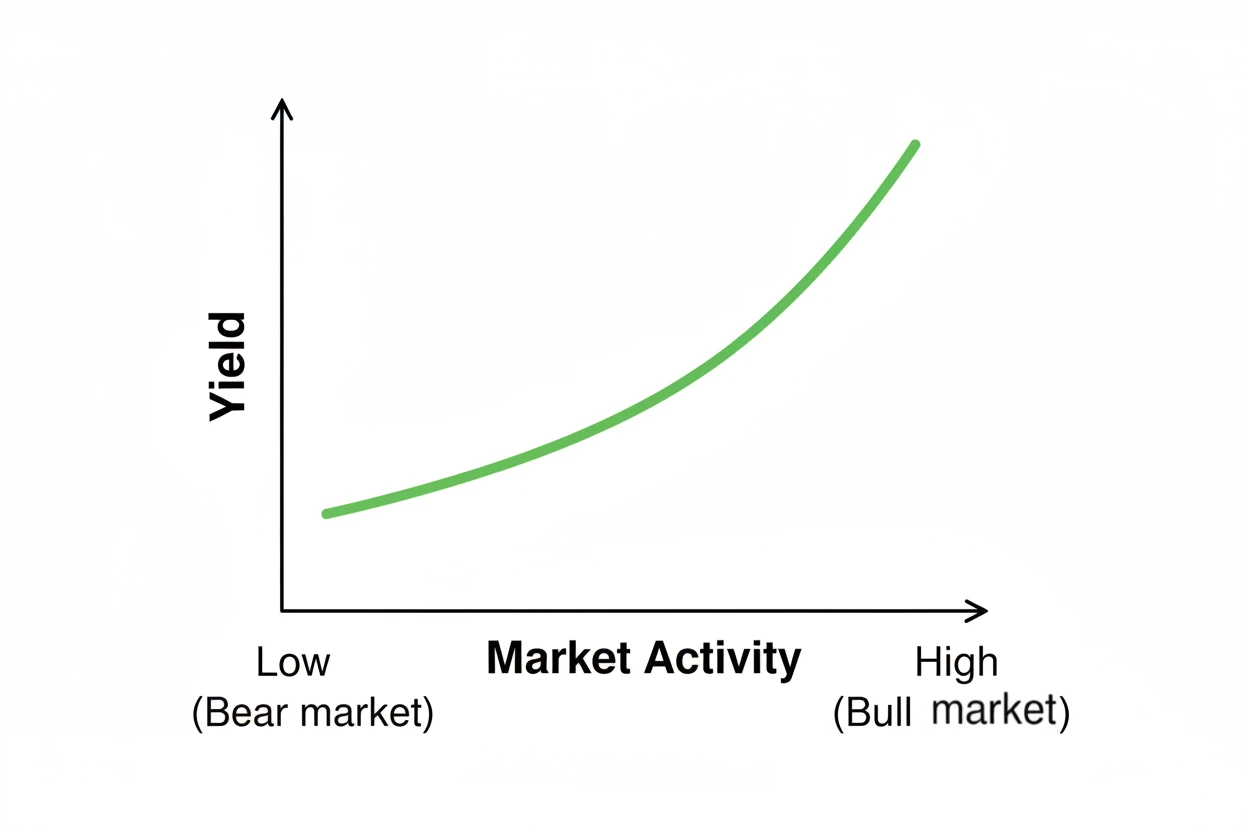
DeFi revenue scales with usage:
| Market Condition | What Happens |
|---|---|
| Bull markets | High volume → high fees → higher yields |
| Bear markets | Lower activity → compressed yields (but still often outperforming TradFi) |
Historically, bull market DeFi yields often exceed 40% APY, while bear market yields compress toward 10–15% APY. Risk-tolerant strategies like looping and tranching can amplify returns — but they amplify failure modes as well.
Higher yield is never free. This is why risk-adjusted analysis matters more than raw APY, and why institutional frameworks outperform intuition.
Most losses are not technical — they are behavioral.
Audits are necessary, not sufficient. Understand the mechanism, not just the logo. A protocol with multiple audits can still have exploitable edge cases or admin key risks.
Phishing remains the most successful attack vector in crypto history. Common tactics include fake airdrops, fake support DMs, and fake front-ends that mimic legitimate protocols.
Defense strategies:
Protocols fail. Teams disappear. Foundations intervene — or don't. Diversification across protocols, chains, and strategy types is essential risk management.
Watch out for APY bait-and-switch tactics, points dilution schemes, and insider rugs disguised as "hacks." Markets punish naivety faster than malice.
Start small. Learn with capital you can afford to lose. DeFi offers extraordinary financial freedom — but only to those who respect its risks and mechanics.
Key principles to remember:
This is precisely why institutional-grade DeFi intelligence matters.
This article explains the mindset. The real edge comes from data, discipline, and continuous monitoring.
On our platform, we publish protocol risk ratings, yield sustainability analysis, and market-cycle-aware strategy research. If you want to stop guessing and start evaluating DeFi like an asset manager — not a gambler — that's what we built.
Resources to bookmark:
No. The passive-income framing — deposit, forget, withdraw richer — sets expectations that match traditional savings accounts. DeFi positions need ongoing attention: APYs change daily, protocols can be exploited, collateral ratios shift with price, and yields often come from reward emissions that decay or expire. Treat every DeFi position as an active management problem, not a yield account.
Understand what is actually generating your yield before depositing. Yield comes from one of: fees paid by borrowers or traders, token emissions (subsidised), staking rewards (inflation), or leverage/speculation. Each source has a different sustainability profile and a different risk profile. If you cannot explain who pays your yield and why, you cannot evaluate the position.
Start with an amount you would be comfortable losing entirely — typically 1-5% of your crypto net worth. Use that capital to learn wallet operations, gas mechanics, slippage, and how a single protocol behaves through one full cycle (deposit, accrue, withdraw, claim). Scale up only after you have lived through one drawdown without panic-exiting.
Investing is choosing positions. Asset management is operating them — monitoring health factors, rotating between yield sources as APYs change, harvesting and reinvesting rewards, watching protocol governance, and exiting when the risk profile shifts. Most DeFi losses come from neglected positions, not from bad initial picks. The job is not done at deposit.
For sound, defensive participation: 3-6 months of consistent practice with small amounts is typical. You will learn to evaluate basic risks, read a position dashboard, and avoid the most common traps. Mastery — running multi-protocol strategies, doing your own protocol analysis, surviving a volatile cycle — takes one to two years of active engagement.

Experienced team of blockchain researchers and analysts dedicated to making DeFi accessible to everyone.


