A bug bounty is worth 10 points in our rating methodology — and it buys something no audit can: a standing incentive for the good guys to find the hole before the bad guys do. Here's who's really hunting your funds, why whitehats are the quiet guardians of DeFi, and what happens when a protocol treats them badly.


In our protocol rating methodology, a bug bounty is worth a full 10 points inside the Smart Contract & Technical Risk pillar. People sometimes ask why we weight it so heavily — it's just a page on a website promising to pay the whitehats who report bugs, right? This article is the long answer. A bug bounty is not marketing. It is the single cheapest insurance policy a protocol can buy, and the way a team runs it tells you almost everything about how it will treat your money when things go wrong.
Here is the uncomfortable timing of DeFi security. A brand-new protocol with under $100M in TVL is usually beneath the notice of serious attackers. There isn't enough money in the contract to justify the effort. That safety is temporary, and it is an illusion of scale, not of code quality.
The danger window opens around the token generation event (TGE). That's when a protocol enters its high-growth phase — TVL climbs, incentives flip on, the treasury swells, and the project finally shows up on the radar of people who do this for a living. Maturity doesn't make you safe; it makes you a target. The bigger the honeypot, the harder the professionals scan it.
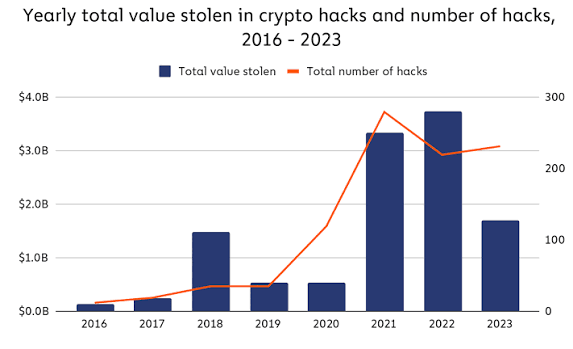 Crypto theft scaled with the money on-chain: from near-zero in 2016 to over $3B a year once DeFi treasuries grew large enough to be worth attacking. The pot got big — and so did the incentive to drain it. (Source: Chainalysis)
And these are professionals. The most notorious is North Korea's Lazarus Group, the umbrella for the DPRK's state-sponsored crypto operations. This is not a metaphor for "some hackers somewhere." North Korea reportedly identifies mathematically gifted children early, funnels them into elite computer-science programs, and drafts the best into what amounts to a national cyber team. Their output is staggering: Chainalysis tracked over $3.4B in crypto stolen across 2025, and DPRK-linked groups alone accounted for roughly $2B of it — including the ~$1.5B Bybit hack in February 2025, the largest crypto theft in history, attributed to Lazarus.
Two things make DeFi uniquely exposed to this kind of adversary:
I'll be blunt about my own view here, and label it as opinion rather than a hard number: given how remote and identity-light this industry is, I would not be surprised if a meaningful slice of blockchain contributors — call it low double digits — are already compromised or infiltrated in some form. You can't prove that figure, and I won't pretend to. But the direction is not speculative: the infiltration is happening at industrial scale, and it has been for years.
The classic image of a DeFi hack is a lone genius spotting a reentrancy bug and draining a pool in one transaction. That still happens — organized teams do run high-intensity sweeps of a project's GitHub and on-chain contracts, find a flaw, and empty the treasury in a single coordinated action.
But the frontier has shifted to social engineering.
The clearest recent case is the Drift protocol hack — roughly $285M, in April 2026. Notably, it was not a smart-contract bug. Starting in the fall of 2025, attackers posed as a legitimate quant trading firm: they showed up at conferences in person, "helpfully" fixed minor issues, and deposited more than $1M of their own capital to build trust — a con that ran for months. The endgame used Solana durable nonces (pre-signed, delayed transactions) and socially engineered real members of Drift's Security Council into signing them. It was attributed to a North Korean group (UNC4736 / AppleJeus). This is the "lie in wait, then close the net" pattern in its purest form — a patient, well-funded, multi-month operation that plants itself and waits.
The older canonical case is the same template: the $625M Ronin / Axie Infinity hack (2022) began with a fake LinkedIn job offer and a malware-laced PDF handed to a senior engineer — spyware that ultimately let attackers compromise a majority of the bridge's validators. These are not smash-and-grabs.
 The modern DeFi attack rarely breaks the lock — it gets hired to hold the key. A patient operator earns a seat at the table, builds trust for months, then closes the net.
Against an adversary like that, an audit is a snapshot — true on the day it was signed. A bug bounty is the standing perimeter that keeps watching after the auditors go home.
For every blackhat draining a treasury, there is a whitehat doing the opposite: hunting for the same bugs and reporting them to the team in exchange for a bounty. The best of them are extraordinarily skilled — often as good as the attackers — and operate with a genuine code of ethics. They are, unglamorously, the immune system of DeFi.
A bug bounty is the contract that keeps that immune system pointed at defense. It says: if you find the hole, we will pay you fairly, and you won't have to think about the other, darker way to get paid. Remove that contract — or honor it dishonestly — and you are quietly asking a very capable person to reconsider which hat they're wearing.
 A fairly-paid bounty tips the scale toward the white hat. The same researcher can go either way — the reward is what decides which.
That's not a hypothetical. Let me walk you through how it goes wrong.
Imagine I'm a whitehat who hunts smart-contract vulnerabilities for a living. I find a critical bug in a protocol — the kind that, lightly weaponized, hands an attacker admin rights and drains the entire treasury. Tens of millions of dollars sit one exploit away.
I check their site. It advertises a $100,000 bug bounty. That's real money, and I want to do this the right way, so I open a ticket in their Discord and disclose the vulnerability privately. The team springs into action — an emergency response, because patching a bug like this properly takes time, maybe days, maybe a week.
Meanwhile, they ask me to keep quiet. Don't mention this in public — it would damage our reputation. This is a high-severity issue; if it leaked, someone could seize admin and take everything. We take it extremely seriously. Please sit tight. Fair enough. I sit tight.
A week later, patch shipped, they come back with a different tone. Turns out the bounty on our website was outdated. We're incredibly grateful you found this, truly — but we've been running at a loss for ages, the bear market crushed our TVL, and we just can't pay what the page said. In other words: they want to stiff me. When I push back — I'll take this to X — they offer a "compromise": some of their token. I check the price. It's down 90% since listing. The bag they're offering is worth a few thousand dollars.
So let's tally it up. I handed them a bug that could have vaporized tens of millions. They want to pay me a few thousand in a dying token and call it generous. And here's the part that should keep every founder awake: I had every technical ability to simply take the money myself. Pull clean ETH from a mixer, deploy a malicious contract, execute the exploit, launder the proceeds back through the mixer. None of that is hard for someone at this level. I chose not to. Why should I eat the disrespect on top of it?
A team that treats whitehats with contempt is broadcasting a dangerous signal. The next researcher who finds a hole in that protocol has just watched what honesty earns. Some fraction of them — the ones whose ethics were already thin — will simply go dark and self-execute. The healthy version is a flywheel: whitehat finds a bug → gets paid fairly → is more motivated to keep hunting and reporting. Break the flywheel and you don't just lose one researcher. You change the incentive for every researcher watching.
This is not a purely hypothetical fear. In 2025, a whitehat who disclosed a bug that reportedly put around $500M at risk on Injective went public, accusing the team of ghosting them for roughly three months and offering just $50,000 — against a program that advertised a payout of up to 10% of funds at risk. Nobody drained Injective; the researcher stayed white. But the episode became a very loud, very public referendum on what a protocol's word is worth — and every skilled hunter in the space was watching how it resolved. That reputational damage is the cheap version of this failure mode. The expensive version is the one where the researcher decides the disrespect isn't worth it.
I want to zoom out, because this dynamic isn't unique to DeFi.
Years ago I followed a game-modding community where a few talented developers built genuinely great mods for free — fast updates, no paywall, pure love of the craft. And inevitably, a subset of players started treating a volunteer like a hired product manager: Why is the update late? It's been a month, what are you even doing? This is an open-source mod. Nobody is on payroll. It's built out of enthusiasm. Eventually one exhausted developer snapped and shipped the next version with a virus baked in, infecting the ungrateful players' machines.
I don't endorse it, but I understand the psychology exactly. When you pay a company, you've earned the right to complain — they took your money. But an open-source project is a commons — public space, sustained by goodwill. When people take from the commons long enough, entitlement replaces gratitude, and they start acting like the volunteer owes them. Every time that happens, the commons shrinks, and life gets harder for everyone still contributing to it.
Whitehats are the security commons of DeFi. Treat them like adversaries or like servants, and you shrink the pool of people willing to protect you.
The whitehat-getting-cheated story has a structural fix, and it already exists. Dedicated crypto bug bounty platforms sit between the project and the researcher, so payment isn't purely a matter of the team's goodwill:
| Platform | How it works | Why it helps whitehats |
|---|---|---|
| Immunefi | The dominant crypto bug bounty marketplace — over $112M paid to whitehats to date, with per-program max rewards reaching the millions (MakerDAO ran a $10M program; the record single payout was $10M to satya0x for the Wormhole bug in 2022). | Standardized severity tables plus a two-stage dispute system: non-binding mediation, then binding arbitration through the London Chamber of Arbitration — marketed as "the internet's first bug-bounty court" — with on-chain escrow via Immunefi Vaults for opt-in programs. |
| HackenProof | Bug bounty and triage platform run by security firm Hacken. | Third-party triage and a formal disclosure process reduce "he-said-she-said" disputes. |
| Sherlock / Cantina / Code4rena | Competitive audit contests — many researchers review code in a fixed window for a shared prize pool. | Payment is escrowed and rules are public before work starts, so the project can't move the goalposts after the bug is found. |
The point isn't which logo is on the page. It's that a bounty run through a reputable platform carries a degree of enforceability and reputational accountability — Immunefi's arbitration path exists precisely so a payout isn't left to a team's mood. A project that stiffs a whitehat on Immunefi burns its standing with the entire security community at once. A self-hosted "$100k bounty" mentioned once in a blog post carries none of that weight — and, as the story above shows, is exactly the kind that quietly evaporates when the bill comes due.
Here's the honest economics. Plenty of protocols simply don't have the cash to honor a large bounty.
My advice to those teams is direct: set aside a slice of the token supply or the community treasury specifically to pay for bugs. It matters enormously. And if your circumstances have changed, update the website and offer less — a smaller, honest bounty you actually pay beats a headline number you default on. The default is what radicalizes your guardians.
So here is where the 10 points come from. Our rating engine scores sub-dimension 1.4 (Bug Bounty & Incident History) like this:
| Bug bounty status | Points (of 10) |
|---|---|
| Active bounty, $500k max reward or more | 10 |
| Active bounty, $100k – $499,999 | 7.5 |
| Active bounty, $1 – $99,999 | 5 |
| No bug bounty found (searched engines + major bounty platforms) | 0 |
That is the credit. Past incidents are then subtracted from it:
| Past incident | Penalty |
|---|---|
| Major exploit, users not made whole (>10% TVL; bridges >$10M) | −20 |
| Major exploit, users made whole (recovered, reimbursed, or compensated by vote) | −10 |
| Minor resolved incident (1–10% of TVL) | −5 |
| De-minimis incident (under 1% of TVL, contained and fixed) | −2.5 |
| Downstream exposure — the protocol's own code never failed, users made whole | −2 |
| Non-exploit operational event (depeg that recovered, hijacked frontend with reimbursement) | 0 |
Two things follow from that shape. The bounty tier is the base, not a starting gift — a protocol with no programme begins at zero and can only go down; it does not begin at ten and lose a couple of points for the omission. And the subfield can go negative. A protocol that lost user money has earned a charge bigger than a ten-point field can hold, and we let the excess carry into the category total rather than quietly capping it at zero. An incident more than three years old whose root cause has been retired carries half its penalty, and one more than five years old stops counting altogether; if the code that failed is still running, the penalty neither fades nor expires.
Our rule is simple and unforgiving: if a search of the web and the major bounty platforms (Immunefi, HackenProof, and peers) turns up no bug bounty at all, we treat the protocol as having none — and it scores zero on this dimension. In the context of a 40%-weighted technical pillar, ten points is not the whole game. But it is a load-bearing pillar of DeFi security, and its absence is a real, deliberate signal. A protocol that won't spend anything to let the good guys in has, whether it means to or not, left the door open for everyone else.
This article is research and commentary, not financial advice. The threat descriptions are generalized; specifics of any named incident are drawn from public reporting. Always do your own research before committing funds to any protocol.
A bug bounty pays whitehat hackers to find and privately report vulnerabilities before attackers exploit them. Unlike an audit, which is a one-time snapshot, a bounty is a standing incentive that keeps skilled researchers pointed at defense long after launch. It's often the cheapest insurance a protocol can buy, and DeFi Sentinel weights it as 10 points inside the Smart Contract & Technical Risk pillar of its rating methodology.
Both hunt for the same smart-contract vulnerabilities, but a whitehat reports the bug to the team in exchange for a bounty, while a blackhat exploits it to drain funds. The best whitehats are as skilled as attackers and operate by a code of ethics — they are effectively DeFi's immune system. A well-funded, fairly-paid bug bounty is what keeps talented researchers choosing the whitehat path.
Increasingly, organized and state-sponsored groups. North Korea's Lazarus Group is the most notorious: DPRK-linked actors stole roughly $2B in crypto in 2025, including the ~$1.5B Bybit hack. Attacks have shifted from pure code exploits to long-con social engineering — the $285M Drift hack in 2026 ran for months, with attackers posing as a quant firm before socially engineering signers. Remote, anonymous teams are especially exposed to insider infiltration.
It sends a dangerous signal to every researcher watching. In 2025, a whitehat who disclosed a bug putting ~$500M at risk on Injective went public accusing the team of ghosting them and offering only $50,000. Nobody drained Injective, but disputes like it show the reputational cost. The deeper risk is that a stiffed, less-scrupulous researcher decides to exploit the bug themselves instead of reporting it.
Immunefi is the dominant crypto bug bounty marketplace, having paid whitehats over $112M — including a record $10M payout for the Wormhole bug. It offers mediation and binding arbitration so payouts aren't left to a team's goodwill. HackenProof provides third-party triage, while Sherlock, Cantina, and Code4rena run competitive audit contests with escrowed prize pools and rules fixed before work begins.
Sub-dimension 1.4 (Bug Bounty & Incident History) is worth 10 points. An active bounty on a reputable platform with a max reward over $500k scores 10; $100k–$500k scores 7.5; under $100k scores 5; and no bounty found anywhere scores 0. A past major uncompensated exploit (over 10% of TVL lost) carries a 20-point penalty. If web and platform searches find no bounty, we treat the protocol as having none.

Practitioner turned analyst tracking how incentives, liquidity, and capital flows shape DeFi protocols.


