The DeFi Sentinel yield guide as it stood this month: every position on the board with its Safety Score, the mechanism that produces the yield, and the specific thing that would break it. Figures are frozen at publication.


Archived edition — September 2026. The figures below are as they stood at publication and are no longer maintained. For the current board and our standing view, see the DeFi Yield Guide.
The best risk-adjusted yield in DeFi right now is fixed-rate credit against USD.AI's GPU loan book. The October PT — a Principal Token, Pendle's fixed-rate leg, which you buy at a discount and redeem at par on a known date — pays 9.64% at a Strategy Safety Score of 80. Nothing else on our board pays that much and scores that well.
But the honest answer to where should the money go is not on the board at all. Bitcoin is near $77,000. If it reaches $100,000 inside a year, that is 25% — more than any position below, at a risk most readers understand better than a junior reinsurance tranche. We said in August that the bottom was in, with BTC around $64,000. We are keeping the call. We are also saying plainly that it has already paid once, so the arithmetic from here is less generous than it was.
The positions paying the most sit at the bottom of the board, on levered exposure to Strategy's STRC preferred. Three rules hold across every edition: prefer a fixed rate to a floating one when they pay the same; an incentive is not a yield; and at high leverage the borrow rate, not the collateral, is what liquidates you.
The bottom call held, and the way it held is the lesson.
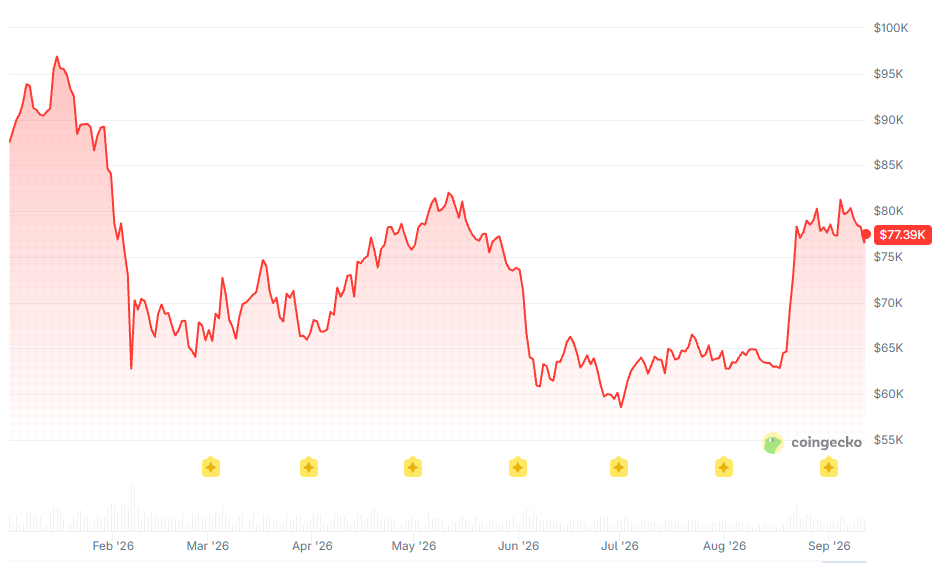 Bitcoin, year to date. The move nobody was positioned for happened in about ten days.
Last month we wrote that Bitcoin had absorbed a $116M hardware-wallet exploit and two exchange wind-downs without making a new low, and that "the marginal seller is exhausted, which is precisely why bad news has stopped moving price." What followed was not a grind higher. Price sat in the low $60,000s through the first three weeks of August and then went nearly vertical.
That is the pattern worth internalising, because it repeats: the market does not deliver the level that consensus agrees on. Last cycle almost everyone wanted $150,000, every top indicator stayed unconfirmed, and it stopped at $126,209. This cycle almost everyone wanted $50,000 as the low. It stopped near $59,000 and left without waiting for anybody. Positioning for the consensus number has been the losing trade in both directions.
The macro variable that is left is the Fed, which meets on 16 September 2026. Markets currently lean toward a hike rather than a cut, and forecasters disagree sharply about it — but either way it is largely priced, and it is no longer the thing that decides this market's direction. What it does decide is the floor: with policy at 3.50–3.75%, lending a stablecoin on a blue-chip money market now pays roughly the policy rate and nothing more. Every yield below is measured against that floor.
Two pieces of news moved actual positions this month rather than sentiment.
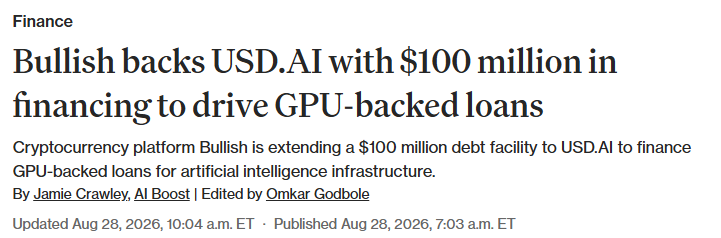 The demand side of the GPU loan book stopped being the open question.
Bullish extended USD.AI a $100M stablecoin debt facility on 28 August, and said it intends to list sUSDai — which matters as much, because a centralised venue quoting the asset is an exit that does not depend on an on-chain pool. Days before that, NVIDIA reported a $96.2B quarter with data-centre revenue up 117% year over year and guided to roughly 70% growth for FY2028 while stating explicitly that the guide is supply-constrained. Read plainly: the hardware securing these loans is rented out faster than it can be built.
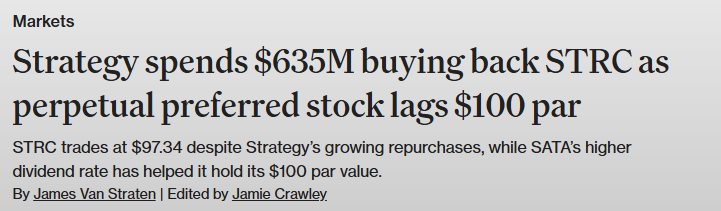 The bid is real. Par is still not restored — and that gap is the whole trade.
The other is Strategy. It repurchased 1,810,885 STRC shares for $176.3M between 31 August and 7 September, at an average of about $97.48, with roughly $1.19B of authorisation left. It also resumed buying Bitcoin — 4,603 BTC at an average of $80,318 in the week ending 30 August, its first purchase in ten weeks. Critics call that selling low and buying high, and on the tape they are right. The thing that matters to a STRC-collateral holder is different: the company keeps choosing the preferred over the common, and it is now doing so with cash rather than with Bitcoin sales.
Sorted by Safety Score, not by yield. That ordering is the point — a rate aggregator can tell you what a position pays, and none of them will tell you whether to take it.
| Safety | Position | APY | Risk | Where the yield comes from |
|---|---|---|---|---|
| 94 | Aave v3 Supply USDT (Ethereum) Ethereum | 3.91% | Medium | 3.91% USDT Lending Interest |
| 92 | Fluid Lending USDT (Ethereum) Ethereum | 4.51% | Medium | 4.51% Lending APY |
| 80 | PT-USDai (Arbitrum) Oct 2026 Arbitrum | 9.64% | Medium | 9.64% Fixed PT Yield |
| 75 | PT-sUSDai (Arbitrum) Oct 2026 Arbitrum | 11.96% | Medium | 11.96% Fixed PT Yield |
| 71 | LP-reUSD (Ethereum) Dec 2026 Ethereum | 9.00% | Medium | 7.02% Underlying Yield · 0.07% Swap Fees · 0.34% PENDLE Rewards |
| 67 | PT-reUSDe (Ethereum) Dec 2026 Ethereum | 18.33% | Medium | 18.33% Fixed PT Yield |
| 59 | PT-apyUSD (Ethereum) Nov 2026 Ethereum | 14.59% | Medium | 14.59% Fixed PT Yield |
| 42 | PT-sUSDat (Monad) Jan 2027 Monad | 17.41% | Medium | 17.41% Fixed PT Yield |
Figures as they stood on 25 September 2026, sorted by Safety Score — not by yield. This is an archived edition and these numbers are no longer updated; the current board is on the DeFi Yield Guide.
These numbers are read live from our strategy database, so they are the same figures the strategies page shows and they are never frozen at publication. The judgement below them is what changes monthly.
| Since August | Change | Why it matters |
|---|---|---|
| The spot call | Held, and it paid | We called the bottom with BTC near $64,000. It is near $77,000. Keeping a call after it works is harder than making it, and the reward-to-risk is genuinely thinner now — but not thinner than a 6% stablecoin position |
| USD.AI | Promoted to the top of the credit stack | A $100M facility from Bullish plus a supply-constrained NVIDIA guide. The question was never the collateral's price, it was whether anyone still wants to rent it. That question closed |
| LP-sUSDe on Monad | Dropped from the board | Last month's highest-scoring position. It pays 8.26% now, well below where it was in August. The subsidy compressed exactly as "an incentive is not a yield" says it will. Nothing broke; the incentive simply got smaller |
| Both looped positions | Dropped from the board | Not because they failed. sUSDS/USDT still pays 0.30% and the apyUSD loop still pays 32.09%. But fixed-rate rows now pay comparable money with no liquidation price attached, which makes the leverage unpaid-for |
| STRC complex | Investable, still small — and now measurable | $176.3M repurchased in a week at ~$97.48. The buyback is real, par is not restored, and Strive's SATA is holding par on a higher dividend. The bid has a competitor now |
| Points | One season worth farming, two we are staying out of | APYX's TGE is fixed for 13 October, CHIP's season ends 15 October, and Saturn's rolled into a new season ending 8 December — so what looked like three closing seasons in August is one clean trade and two open-ended ones |
| Money markets | Added to the board | Lending a stablecoin now pays roughly the Fed's policy rate. That is not exciting, but it is the number every position here has to beat, so it belongs on the board rather than in a footnote |
The mechanism. You supply a stablecoin, borrowers pay a utilization-driven rate, you take it. No maturity, no leverage, no token you have to model. It is the least interesting row here and the most important one, because it is the alternative to every other row.
The thing worth noticing is that the same dollar earns different money. Supplying USDT to Aave v3 pays 3.91%; supplying the same USDT to Fluid pays 4.51%. That spread is a utilization difference between two venues we score 94 and 92, not a subsidy and not a credit premium. It is the cheapest improvement available in this guide and most people leave it on the table out of habit.
What breaks it: essentially nothing, which is the point — but the rate is floating, and it tracks policy. If the Fed cuts, this row falls first and furthest, and everything fixed-rate below suddenly looks better in hindsight than it does today.
The mechanism. Fixed-rate exposure to USD.AI's GPU-backed lending book. Loans are collateralised by compute hardware, so the underwriting question is whether GPU rental rates hold — and this month NVIDIA answered it about as loudly as a supplier can.
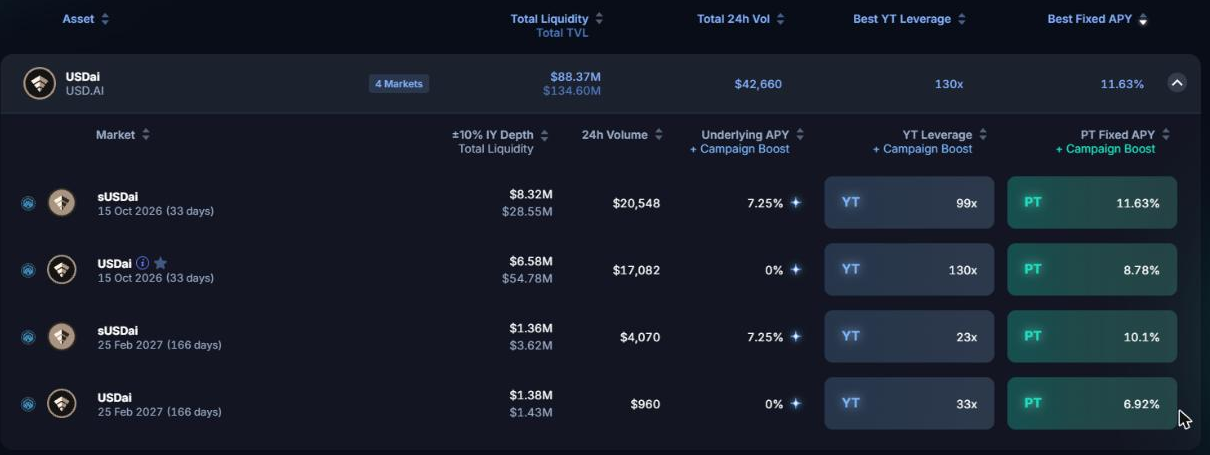 Four markets, two maturities. Note the depth column — the October pools are several times deeper than February's.
The two assets are two different trades. USDai is the plain dollar, backed by PYUSD and Treasuries with the loan book behind it; its PT pays 9.64% and scores 80. sUSDai is the staked version that takes the GPU credit risk directly; its PT pays 11.96% and scores 75. Roughly three extra points for stepping from the backed dollar onto the loan book. That is the decision, and it is a clean one.
Prefer October to February in both cases. February pays 7.57% on USDai and 9.95% on sUSDai — less than October, for four extra months of credit exposure to an AI-capex cycle. When the term structure is flat or inverted, duration is a risk nobody is paying you for. The October pools are also far deeper, which makes them the better exit if you need one.
A PT converges to its underlying 1:1 at maturity, so holding to the date removes price risk entirely. Selling early does not.
What breaks it: sustained H200 rental rates falling toward $2/hour, which would mean the collateral is repricing rather than the borrower struggling. They have not. The second-order risk is faster than that: TVL has roughly doubled this year, and a loan book that grows that quickly is a loan book underwriting borrowers it met recently.
The mechanism. On-chain reinsurance premiums. Re writes real insurance risk and funds it with stablecoin deposits split into two tranches. reUSD is senior and reUSDe is junior — the junior tranche absorbs losses first, and only when it is wiped out does the senior take any. The several-point step between them is not a bonus. It is the price of sitting lower in the loss waterfall, quoted honestly.
Senior via the LP — the Pendle liquidity-provider leg, which earns pool fees and incentives at a floating rate rather than a fixed one — pays 9.00% at a score of 71. Junior via the PT pays 18.33% at 67.
On the junior leg, take the PT over the LP. They price within about a point of each other — the LP is at 17.40% — and when fixed and floating pay the same, fixed is strictly better: the PT locks your return the moment you buy, while the LP's depends on pool utilization for the remaining months. That is certainty offered for free.
What breaks it: a PT fixes the yield, not the credit. A bad claims year means redemption below par, and this position runs straight through the tail of Atlantic hurricane season. A single severe landfall is the scenario the junior tranche exists to absorb, and December is not far enough away to have cleared it.
The mechanism. Both are synthetic dollars collateralised by dividend-bearing preferred shares, dominantly STRC — Strategy's variable-rate perpetual preferred, designed to hold a $100 par. Apyx wraps it as apxUSD/apyUSD; Saturn wraps it as USDat/sUSDat. You are being paid the preferred's dividend, levered by the wrapper's structure, minus whatever the market charges for the wrapper's own risk.
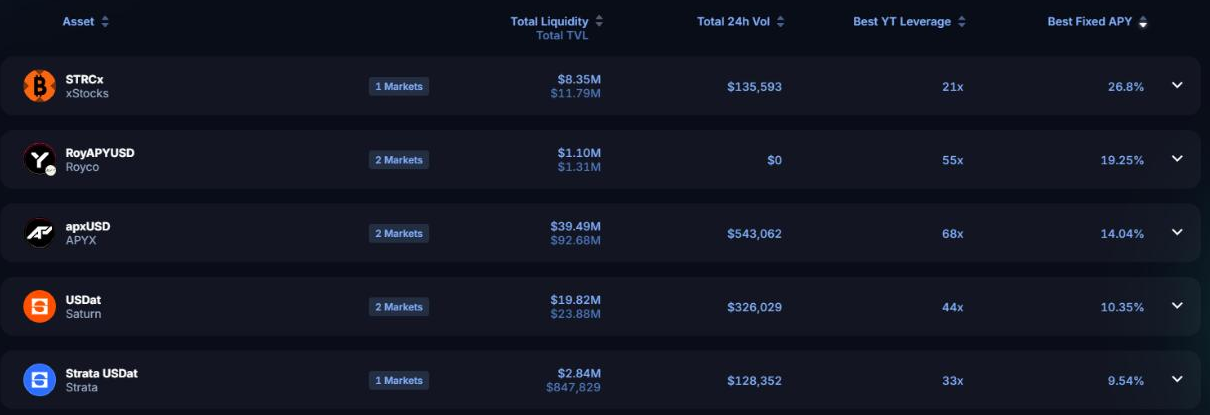 The STRC family on Pendle. Liquidity, not yield, is what separates these rows.
PT-apyUSD, November, on Ethereum pays 14.59% at a score of 59. It needs no bridge — you swap into apyUSD on mainnet and buy the PT. It is the more accessible of the two and the one with thinner cover: Apyx's pool liquidity has fallen materially, and a levered preferred wrapper with a shrinking pool is a position that is easy to enter and awkward to leave.
PT-sUSDat, January, on Monad pays 17.41% at a score of 42 — the highest rate on the board and the lowest score, which is not a coincidence. Most of what it pays above roughly 12% is Monad subsidising liquidity onto its own chain, not Saturn earning more. Apply the incentive rule: size it for the day the subsidy stops, not the day it is running. You also have to bridge, and the bridge is the part people underestimate.
What breaks it: an STRC depeg. This is the assumption to watch rather than the yield. Strategy is buying the preferred back with cash and it is still trading below $100, while Strive's SATA holds par on a higher dividend rate — meaning the marginal buyer has somewhere else to go. The wrappers move more than the collateral does: apxUSD has traded near $0.90–0.93 on a single selloff. Add a roughly 20-day cooldown on unwinding apyUSD, and a young asset we have not yet rated. Small position, checked often.
Buying YT — the Yield Token, Pendle's other leg, which pays you all the yield and incentives a position generates and is worth exactly zero at maturity — ahead of an airdrop is the highest-variance thing in this guide. It gets no Safety Score because the score grades a yield position, and this is a bet on a token price. If the airdrop disappoints you lose most of the stake.
USD.AI is the one we would take. CHIP's fully-diluted valuation has roughly doubled off its lows to around $454M as of 11 September, TVL is near $554M, and the season ends 15 October — about five weeks. A short window is the entire argument: five weeks is not long for a token with a live lending business and a fresh $100M facility behind it to fall apart, and the points already earned are close to settled. Buy the sUSDai YT if you want the calmer version, the USDai YT if you want the aggressive one, and prefer maturities that expire on or before the airdrop date.
Two caveats, and they cut the other way. USD.AI has just joined Fluid's looping incentive program, which mints new points and dilutes existing ones — with five weeks left that dilution is bounded, but it is not zero. And the case rests entirely on CHIP holding its price. Model it yourself before committing: USD.AI calculator.
APYX and Saturn we are staying out of. APYX's TGE is now fixed for 13 October and will not move, which removes the timing risk — but the opening valuation is genuinely unknowable, the best farming window was the August maturity, and the points system has no meaningful audit. It has repeatedly opened new markets on new chains at higher point rates to attract deposits, and every one of those dilutes everybody already in. Saturn's season now runs to 8 December, which turns a five-week trade into a three-month one at the same uncertainty. Neither is a bad protocol. Both are bad risk-reward on the YT right now. APYX calculator.
The uncomfortable conclusion of a yield guide: at these levels, spot is the better trade.
Bitcoin near $77,000 reaching $100,000 in a year is 25%. The safest rows on the board pay the policy rate. The rows paying 6–10% carry credit risk you have to actively monitor, and the ones paying 20%+ carry a liquidation price. None of them are 25%. That gap is not an argument for abandoning DeFi yield — it is an argument for being honest about what the yield is for, which is the part of the portfolio that should not move.
If you want more than 25%, 2–3x perpetual leverage on spot is a more legible way to get it than a levered preferred wrapper, because you can see the liquidation price and top it up. Keep real margin aside for a violent wick; this market has now produced two of them inside six weeks.
We are also watching HYPE, and will write it up separately. It sits at an all-time high with community attention maxed out, which is normally the moment to look away — and it is the one we think is worth looking at anyway.
Informational only, not financial advice. Yields, maturities, borrow rates and risk conditions change quickly — verify current figures on-chain before investing, and never commit more than you can afford to lose.
On a risk-adjusted basis, fixed-rate credit against USD.AI's GPU loan book led the board: PT-USDai for October at 10.86% with a Safety Score of 80, and PT-sUSDai at 12.09% scoring 75. Behind them sat PT-reUSDe on on-chain reinsurance at 18.33% (score 67), PT-apyUSD at 14.59% (score 59), and PT-sUSDat on Monad at 17.41% — the highest rate on the board and the lowest score at 42, which was not a coincidence.
Bullish extended USD.AI a $100M stablecoin debt facility on 28 August 2026 and said it intended to list sUSDai. The second part mattered as much as the first: a centralised venue quoting the asset is an exit that does not depend on an on-chain pool. Days earlier NVIDIA had reported a $96.2B quarter with data-centre revenue up 117% year over year and guided to roughly 70% FY2028 growth while stating the guide was supply-constrained — meaning the GPUs securing these loans rent out faster than they can be built.
Not in September. Strategy repurchased 1,810,885 STRC shares for $176.3M between 31 August and 7 September at an average of about $97.48, with roughly $1.19B of authorisation left, and it funded that with cash rather than Bitcoin sales. Par was still not restored at the time, and Strive's SATA was holding par on a higher dividend — so the marginal buyer had somewhere else to go. The gap between the bid and $100 was the entire trade for anyone holding an STRC-collateralised wrapper.
Not because any of them broke. The looped sUSDS/USDT and apyUSD positions were still paying, but fixed-rate rows had come to pay comparable money with no liquidation price attached — which makes the leverage unpaid-for. The rule behind the decision holds in every edition: at high leverage the borrow rate, not the collateral, is what liquidates you, and you should not accept that exposure unless something is actually paying you for it.

Practitioner turned analyst tracking how incentives, liquidity, and capital flows shape DeFi protocols.


