Hyperliquid is an exchange that owns its own chain, and HYPE is one of the few tokens in DeFi where fees genuinely reach holders. But the share reaching them has fallen from 94% to 74% in four quarters. Five revenue lines, three scenarios, and the one number the current price already assumes.


HYPE printed a new all-time high of $94.48 on 19 September 2026, the day after Hyperliquid switched on native lending. At $92.22 the token carries a $20.5B market cap against roughly $755M of annualized fees — a 27.2x price-to-fees multiple, well above where it has traded for most of its life.
That is a strange place for a business whose revenue is down 43% from its peak.
Both facts are true, and reconciling them is the whole exercise. This is a single-name application of the framework in How to Value a DeFi Token: first establish what the business actually is, then ask what the price already assumes about it.
Most decentralized exchanges are applications renting space on someone else's blockchain. Hyperliquid is the opposite: it built a purpose-built L1 whose only job is to run an order book. Orders match in a native execution environment called HyperCore; a separate general-purpose EVM layer, HyperEVM, hosts the surrounding DeFi ecosystem.
The practical consequence is that Hyperliquid has a real central-limit order book with exchange-grade latency, rather than an AMM pretending to be one. That is why it took share from centralized venues rather than from other DEXs, and why it now runs anywhere from 13% to 44% of on-chain perpetual volume depending on whose methodology you accept — a spread worth remembering, because every bottom-up valuation of this token is built on top of it.
The mistake most HYPE analysis makes is treating the protocol as a perps exchange with a token attached. As of September 2026 there are five distinct revenue lines, and they have almost nothing in common with each other:
| Leg | What it is | Live since | Scale today | Share reaching holders |
|---|---|---|---|---|
| Crypto perps + spot | The original order book | Nov 2024 | ~$755M/yr all-in | ~99% of protocol share |
| HIP-3 builder markets | Anyone staking 500k HYPE deploys a perp market — mostly tokenized stocks and RWAs | Oct 2025 | Over 60% of platform volume | 49.5% — deployers keep half |
| HIP-4 outcome markets | Native prediction markets | May 2026 | ~1,000 markets, volume still small | ~60% (mixed) |
| AQAv2 reserve yield | ~90% of yield on USDC held on-platform | Aug 2026 | ~$11–13M per 30 days | ~99% |
| Native lending | Borrow USDC/USDT against HYPE or BTC | 18 Sep 2026 | $269M borrowed day one | Not yet measurable |
Legs one through three are volume businesses: they rise and fall with crypto speculation. AQAv2 is not. It is paid on the dollar balance sitting on the exchange multiplied by the Treasury bill rate, which makes it the only line that does not collapse in a crypto winter — and, awkwardly, the only one that gets worse when rates fall in a bull market.
Lending, launched one day before this was written, is the newest and least understood. It matters twice: it earns an interest spread directly, and it pulls more USDC onto the platform, which is the base AQAv2 is paid on.
This is what separates HYPE from most governance tokens. Roughly 99% of the protocol's fee share is routed to an Assistance Fund that buys HYPE on the open market and holds it, with governance-approved burns of a portion. Total supply has fallen from the genesis 1 billion to 955.3 million — about 44.7M tokens, or 4.5%, permanently retired.
So HYPE is not a claim on cash flow in the legal sense, but it is one in the mechanical sense: revenue converts into buy pressure automatically, without a vote. In our capture taxonomy that puts it in the transitional class rather than the cash-flow class — the mechanism is live and large, but young enough that it has not yet survived a full bear market.
Here is the single most important table in this article. It is not fee growth. It is the share of fees that reaches token holders, quarter by quarter, straight from DefiLlama:
| Quarter | Protocol fees | Holder revenue | Capture rate |
|---|---|---|---|
| 2025 Q2 | $180.4M | $169.8M | 94.2% |
| 2025 Q3 | $356.7M | $289.8M | 81.3% |
| 2025 Q4 | $295.0M | $226.1M | 76.6% |
| 2026 Q1 | $217.5M | $165.3M | 76.0% |
| 2026 Q2 | $201.8M | $148.6M | 73.6% |
| 2026 Q3 (to date) | $164.5M | $122.5M | 74.4% |
Two things happened at once, and they are the same thing. Fees fell 43% from the Q3 2025 peak — and the slice reaching holders fell from 94% to 74%. Buybacks dropped from roughly $290M a quarter to $149M, a decline steeper than the revenue decline that caused it.
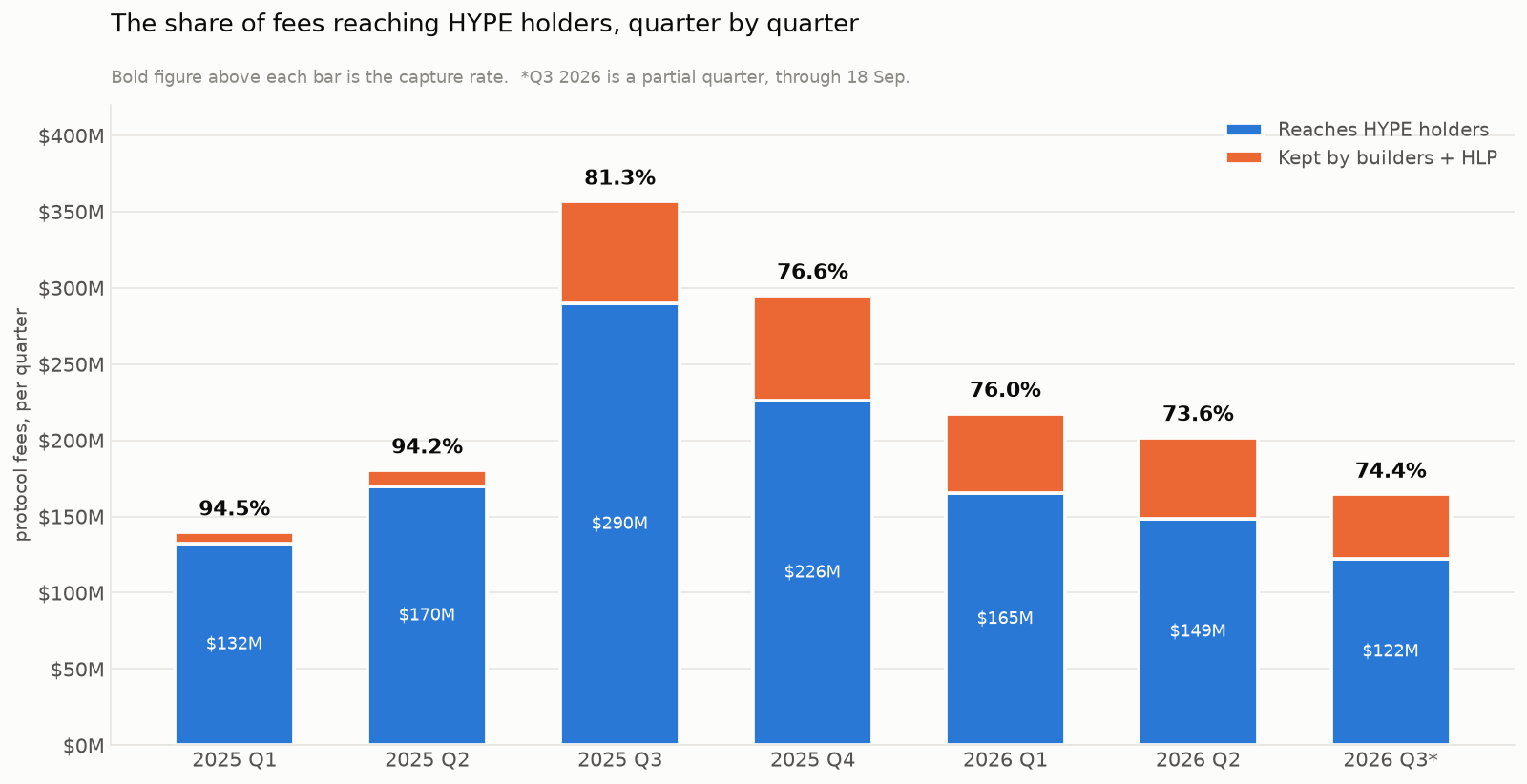
The same chart says both things at once. The bars shrink — that is the 43% revenue decline. The orange slab grows — that is the capture rate falling from 94.5% to 74.4%. Q3 2026 is a partial quarter, so read its height with care; the percentage above it is the honest figure.
The mechanism is HIP-3. Builder-deployed markets pay their deployer half of all trading fees, and those markets went from around 2% of Hyperliquid's volume in early 2026 to over 60% today. The protocol's growth engine and its revenue leak are the same product. You can watch it in the accounts: supply-side revenue on the perps adapter ran $14.87M against $64.52M of fees in August 2026 — 23% — versus roughly 3% in July 2025.
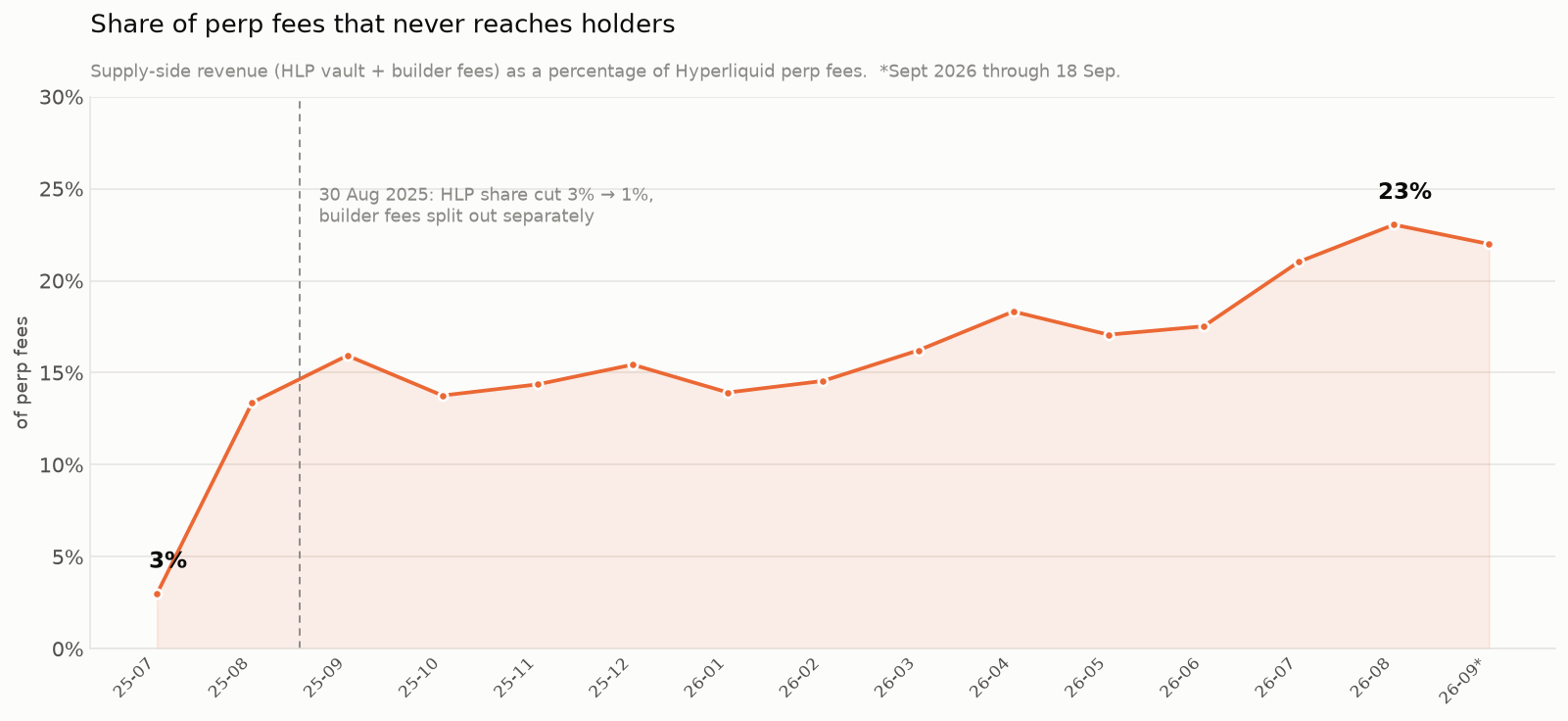
The leak, month by month. The step in August 2025 is a rule change, not a trend — but everything after it is. Since January 2026 the line has gone one way.
Synthetix founder Kain Warwick put it plainly: "The fact that Hyperliquid has landed on 50% of the fees is a bit crazy. I can't see how that's sustainable."
There is a concentration problem stacked on top. A single builder, trade.xyz, holds over 90% of HIP-3 open interest. The fastest-growing half of the business currently depends on one counterparty.
An earlier internal version of this model argued that DefiLlama's Hyperliquid figure excludes HIP-3, and therefore understated the business. That is no longer true. The hyperliquid-perps adapter now explicitly includes "perps trading fees on crypto and HIP-3 deployed markets + builders fees," with builder fees stripped out only at the holder-revenue line. The change landed across April–July 2026.
To be precise about what this does and does not break. The scenarios below are built from volume times fee rate, not by adding legs on top of today's number, so their totals stand. What fails is the framing: you cannot claim the reported fee base understates the business when HIP-3 is already inside it, and you cannot convert a scenario into a "share of the last measured peak" as though that peak were crypto-core-only. What the adapter change actually did was make the capture-rate erosion visible — a more useful thing than a bigger headline number.
Before any scenario, run the question backwards. At today's $20.5B market cap and a terminal multiple of 25x earnings, the price already requires $821M of annual holder revenue — 1.47x what the protocol currently generates. At a more conservative 20x, it requires 1.83x.
That is the honest starting point. HYPE is not priced for stagnation. It is priced for a recovery to roughly half again its current profitability, before a holder breaks even.
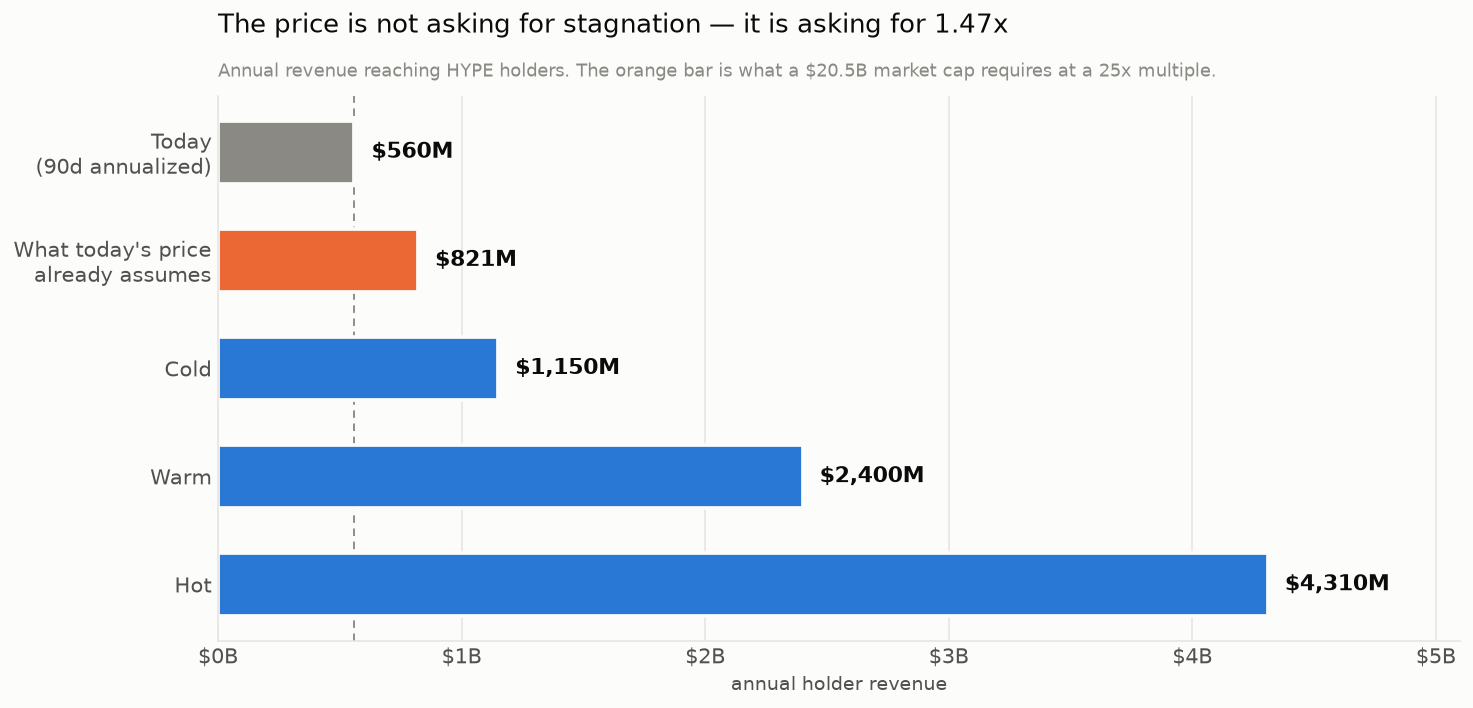
The orange bar is not a forecast — it is arithmetic. It is the holder revenue a $20.5B market cap requires at 25x, and it already sits well above today's grey bar.
This is the part most scenario tables skip, so here is the whole build. Cold, warm and hot are not "bear, base, bull" sentiment labels, and they are not multiples of today's revenue. Each one is a set of explicit values for a handful of observable factors, multiplied out leg by leg. Change a factor, get a different case — that is all a scenario is.
Every volume leg reduces to the same two-term identity:
fee revenue = notional volume × effective fee rate
Which means a scenario is only ever a claim about those two things. So we pin the fee rate first, because every leg is multiplied by it.
| Input | Value | Source |
|---|---|---|
| 2025 market-wide perp volume | $91.7T | CEX $85.3T + DEX $6.38T; DEX share 7.0% |
| Hyperliquid 2025 volume | $3.51T | $6.38T × 55% share of perp DEX volume |
| Hyperliquid 2025 fees | $971.6M | DefiLlama monthly series, summed |
| Implied effective rate | 2.77 bps | $971.6M ÷ $3.51T |
Cross-check: Hyperliquid's peak quarter (Sept–Nov 2025) averaged $113.8M of monthly fees. At 2.77 bps that back-solves to $411B of monthly volume, against contemporaneous reporting of "close to $400B/month." The anchor survives its own reversal.
The honest caveat: 2.77 bps is a derived figure, not a measured one, and it inherits all the uncertainty in that 55% share assumption. At 50% share it becomes 3.05 bps; at 60% it becomes 2.54 bps. Published estimates of Hyperliquid's perp-DEX share run from 39.5% to 70%, so treat this number as ±10% and everything built on it likewise.
The naive approach is "return to 0.8x / 1.0x / 1.3x of the measured peak." We reject it, because that peak was set when perp DEXs were only 7% of the total market and is now a ceiling that systematically understates. Instead, four factors:
| Factor | Cold | Warm | Hot | 2025 actual |
|---|---|---|---|---|
| Market-wide perp volume/yr | $92T | $105T | $130T | $91.7T |
| Perp DEX penetration | 10% | 14% | 18% | 7.0% |
| Hyperliquid share of perp DEX | 40% | 45% | 50% | 55% |
| → Hyperliquid volume/yr | $3.68T | $6.62T | $11.70T | $3.51T |
| Effective fee rate | 3.0 bps | 2.6 bps | 2.2 bps | 2.77 bps |
| Leg 1 fees | $1,168M | $1,820M | $2,723M | $972M |
Two design choices worth defending. First, Hyperliquid's share falls as the market grows in every case — competition is assumed, not wished away. Second, the fee rate compresses as volume rises, which is not a pessimism knob but an arithmetic necessity: Hyperliquid's fee tiers are keyed to 14-day volume, so heavier traders automatically ratchet down to lower taker rates, and rival venues have run 0% standard taker fees. A scenario that triples volume while holding the fee rate fixed is internally contradictory. Leg 1 includes a +5.8% uplift for spot order book plus HLP, measured off the trailing year.
| Leg | Driver | Cold | Warm | Hot | Basis |
|---|---|---|---|---|---|
| HIP-3 | volume multiple | 2x | 5x | 12x | On $1.33T/yr notional today |
| effective rate | 1.0 bps | 1.5 bps | 1.5 bps | vs 0.49 bps today; 1.5 bps ≈ the announced 3x repricing | |
| fees | $267M | $1,000M | $2,400M | 4% / 16% / 39% of the $6.2B CME + Nasdaq fee pool | |
| HIP-4 | share of volume | 5% | 15% | 30% | Of a $607B/yr prediction-market pool |
| effective rate | 30 bps | 40 bps | 50 bps | Kalshi takes 114 bps; HIP-4 charges nothing to open | |
| fees | $91M | $364M | $911M | ||
| AQAv2 | USDC balance | $5B | $12B | $20B | ~$5–5.5B on platform today |
| reserve yield | 2.0% | 3.0% | 3.0% | × 90% protocol share | |
| revenue | $90M | $324M | $540M |
HIP-3 is benchmarked against revenue, not notional — CME's notional is dominated by ultra-low-fee rate products, so comparing volume to volume would mislead badly. Even the hot case only claims 39% of the combined CME and Nasdaq fee pool.
The hot AQAv2 case deliberately holds yield at 3.0% rather than pushing higher, because a crypto melt-up usually coincides with rate cuts. You are not allowed to maximize "crypto mania" and "high rates" in the same column.
Holder revenue is not the total times one number. Each leg keeps a different share, so they are weighted individually — this is the step that makes the blended capture rate fall as the mix shifts:
| Leg | Capture | Cold | Warm | Hot |
|---|---|---|---|---|
| Crypto core | 75% | $1,168M | $1,820M | $2,723M |
| HIP-3 | 49.5% | $267M | $1,000M | $2,400M |
| HIP-4 | 60% | $91M | $364M | $911M |
| AQAv2 | 99% | $90M | $324M | $540M |
| Total fees | $1.62B | $3.51B | $6.57B | |
| Holder revenue | $1.15B | $2.40B | $4.31B | |
| Blended capture | 71.3% | 68.4% | 65.6% | |
| Crypto core as share of fees | 72% | 52% | 41% |
HIP-3's 49.5% is not a judgement call: deployers take 50% by protocol design, and 99% of the remainder goes to the Assistance Fund. AQAv2's 99% is structural for the same reason — it routes straight to the fund with no counterparty to split with.
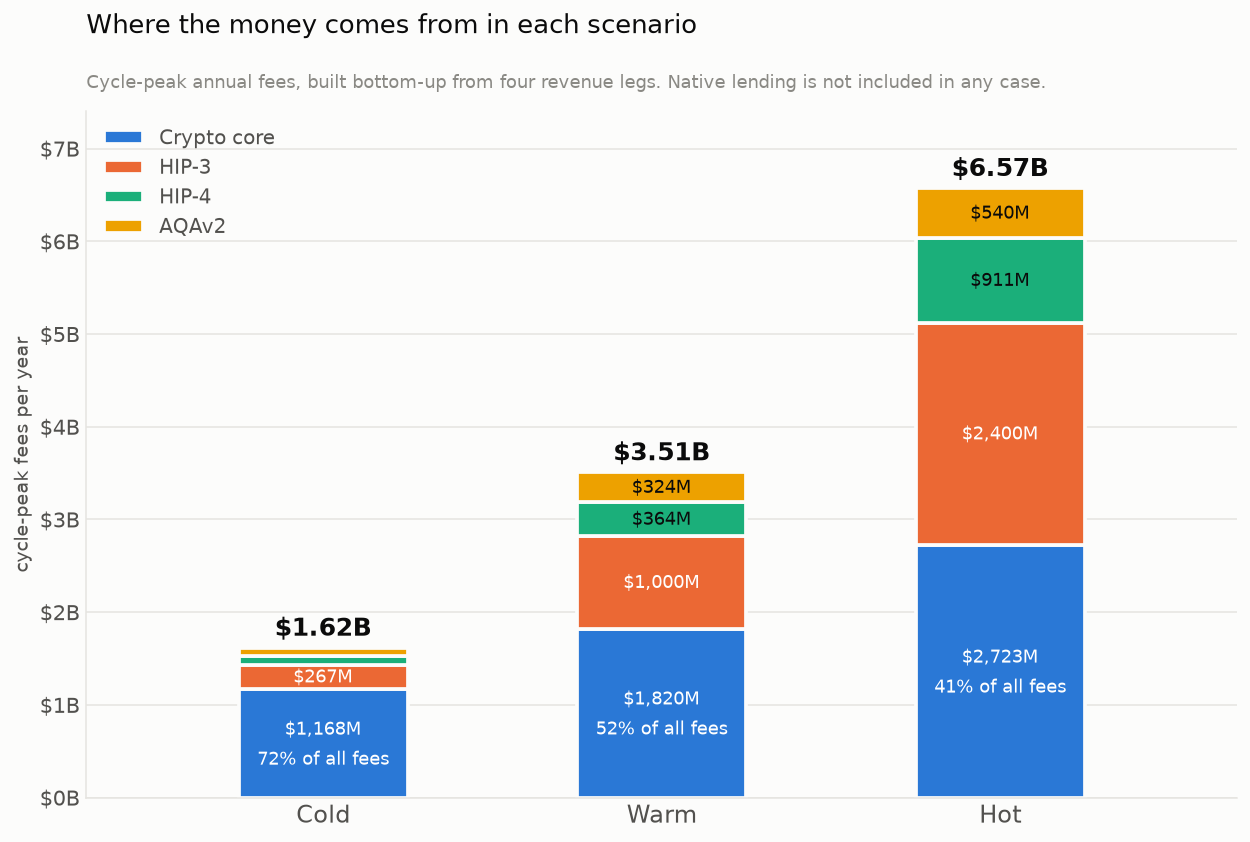
What each scenario is actually claiming. Watch the blue block: it is 72% of the cold case and 41% of the hot one. The bull case is a bet on the other three colours.
| Cold | Warm | Hot | |
|---|---|---|---|
| Holder revenue | $1.15B | $2.40B | $4.31B |
| Terminal multiple | 25x | 25x | 25x |
| Net dilution | 1.00 | 1.00 | 1.00 |
| Implied market cap | $28.8B | $60.0B | $107.8B |
| Implied price | $129 | $270 | $484 |
| Versus $92.22 today | +40% | +192% | +425% |
The whole point of building it this way is that you can see which is which:
| Input | Status |
|---|---|
| 2025 fees, capture rates, current volumes and balances | Measured — DefiLlama, CoinGecko, protocol design |
| The 2.77 bps anchor | Derived, ±10% on a contested share assumption |
| Market size, DEX penetration, Hyperliquid share, fee compression | Judged — this is where the scenario lives |
| HIP-3 and HIP-4 volume multiples | Judged, and the weakest links — HIP-4 has almost no history |
| Terminal multiple | Judged, and it moves the answer more than any of the above |
Read the structure row of the summary table before the price row. In the warm case, the crypto order book — the thing everyone actually means when they say "Hyperliquid" — is no longer half the business. In the hot case it is 41%. The bull case for this token is explicitly a bet that tokenized stocks, prediction markets and Treasury-bill yield become the majority of it.
And notice the direction of the capture rate. It falls as the business grows, because the fastest-growing lines are the ones where deployers take half. More revenue and less revenue per token are the same trend here.
One omission is worth stating plainly: none of these three cases includes the lending business, which launched on 18 September 2026 and has no history to extrapolate from. To that extent all three are conservative — though a new leg does not rescue a thesis whose problem is the capture rate, because lending revenue is subject to the same question of who keeps it.
A terminal multiple is where most crypto valuations quietly smuggle in their optimism. Four reference points:
| Reference | Multiple | Note |
|---|---|---|
| HYPE's own price-to-fees, trailing 365d | 6.2x to 18.1x | p10 to p90. It trades at 27.2x today — above its own range. |
| DeFi peer group, 12 tokens | 23x / 31x / 49x | Q1 / median / Q3 |
| TradFi exchanges (CME, ICE) | 19x to 23x | Mature monopoly exchange businesses |
| Coinbase, 2026 expected | 38.8x | Crypto-native, highly cyclical comparable |
We use 25x — near the peer lower quartile and ICE's ten-year median. Pairing peak-cycle earnings with a peak-cycle multiple is the most common error in crypto valuation, and it is double-counting. At 20x the warm case is +134% rather than +192%; at 30x it is +251%. The multiple assumption moves the answer more than the fee assumption does.
One counterintuitive note: bear-market P/E ratios go up, not down. Aave traded at 75x in 2023, its worst earnings year, because the denominator collapsed faster than the price. What compresses in a bear market is absolute market cap, not the multiple.
No discussion of HYPE supply survives contact with Crypto Twitter without the words "Season 3." So it is worth separating the rumor from the number underneath it.
The rumor: Hyperliquid has not officially announced a third airdrop season. Speculation revived through September 2026 on the back of HyperEVM growth and the price making new highs. The froth got literal — in early September, Machi Big Brother (Jeffrey Huang) promoted a Solana meme coin actually named "Season 3 (S3)" on the claim that it pays HYPE to holders. It spiked, then gave back about three-quarters of the move within hours. Treat anything with S3 in the ticker accordingly.
The number underneath it is real, though. Roughly 38.888% of total HYPE supply remains earmarked for community rewards and future emissions — undistributed, unscheduled, and entirely at the Foundation's discretion. That is a far larger overhang than the 23.8% core-contributor allocation everyone tracks on unlock calendars, and unlike vesting, it has no published curve at all.
It cuts both ways, which is why it belongs in a valuation and not just a risk list:
| Effect on HYPE | |
|---|---|
| Demand side | A live airdrop expectation pulls in volume. Farmers trade, stake and use HyperEVM to accrue points — which inflates the very fee base you are valuing. Some portion of today's $755M is mercenary. |
| Supply side | An actual distribution is issuance. Nothing in the 1.00 net-dilution assumption used above accounts for a discretionary community unlock of this size. |
| Reflexivity | Announce it and the fee base gets a temporary boost while the float grows. Never announce it and the farming volume eventually leaves for a venue that will pay for it. |
The honest treatment is that this is not modellable, only flagged. Our scenarios above assume 1.00 net dilution, which the last 90 days of measured supply data support — buybacks and unlocks have run roughly flat. A Season 3 announcement would invalidate that assumption in both directions at once, and no one outside the Foundation knows the size or the date. If you are farming it, read our note on mercenary capital first — this is the textbook case.
Seven things, roughly in order of how much damage they do:
Hyperliquid is one of a handful of DeFi protocols where the phrase "real revenue" survives inspection: money comes in from trading, and 99% of the protocol's share is mechanically converted into buying and burning the token. On the protocol page it screens as a genuine cash-flow business rather than a governance token with a narrative.
But the asset you are buying in September 2026 is not the asset you were buying a year ago. It is shifting from a crypto order book that kept 94% of what it earned into a distribution platform that keeps 74% and falling — bigger, more diversified, more exposed to tokenized equities and Treasury yield, and structurally less generous to the token per dollar of volume.
The price already assumes a 47% recovery in holder revenue. Whether you get paid from here depends almost entirely on whether HIP-3, HIP-4 and lending grow fast enough to outrun the capture rate they are eroding. Run the same decomposition yourself in the DeFi Token Valuation tool — the fee-peak slider is where your own assumption goes, and it is the only input that should be yours rather than ours.
This is scenario arithmetic, not a price target, and nothing here is financial advice. Each scenario stacks several independent optimistic assumptions — market size, DEX penetration, platform share, fee rate, terminal multiple — whose joint probability is far lower than any one of them alone.
Hyperliquid is a derivatives exchange that owns its own Layer 1 blockchain. Orders match on a native execution environment called HyperCore, giving it a real central-limit order book rather than an AMM. As of September 2026 it earns from five lines: crypto perps and spot, HIP-3 builder-deployed markets, HIP-4 prediction markets, AQAv2 yield on USDC reserves, and native lending launched on 18 September 2026.
Yes, mechanically rather than legally. Roughly 99% of the protocol's fee share is routed into an Assistance Fund that buys HYPE on the open market and holds it, with governance-approved burns of a portion. Total supply has fallen from the genesis 1 billion to about 955.3 million — roughly 44.7 million tokens permanently retired. No vote is needed for revenue to become buy pressure.
Two things happened at once. Protocol fees dropped from $356.7M in Q3 2025 to $201.8M in Q2 2026, and the share reaching token holders fell from 94.2% to 73.6% over the same stretch. Quarterly buybacks fell from about $290M to $149M. The decline in holder revenue is steeper than the decline in fees, because HIP-3 builders now take half the fees on the fastest-growing markets.
HIP-3 lets anyone staking 500,000 HYPE deploy a perpetual market, mostly tokenized stocks and real-world assets. Deployers keep 50% of trading fees, so only about 49.5% of gross HIP-3 fees reach holders versus roughly 99% on crypto core. Builder markets grew from around 2% of platform volume in early 2026 to over 60% today, which is why the capture rate keeps falling as the business grows.
Not officially. Hyperliquid has never announced a third airdrop season, and September 2026 speculation is community-driven — a Solana meme coin literally named Season 3 was promoted on the claim it pays HYPE, then retraced about three quarters of its spike within hours. The substantive fact underneath is that roughly 38.888% of total supply remains reserved for community rewards, unscheduled and at the Foundation's discretion.
At $92.22 and a $20.5B market cap, the price already requires about $821M of annual holder revenue at a 25x terminal multiple — roughly 1.47x what the protocol generates today. Scenario arithmetic gives $129 in a cold case, $270 in a warm case and $484 in a hot case, which is +40%, +192% and +425% respectively. These are range boundaries, not probabilities or price targets.

Practitioner turned analyst tracking how incentives, liquidity, and capital flows shape DeFi protocols.


